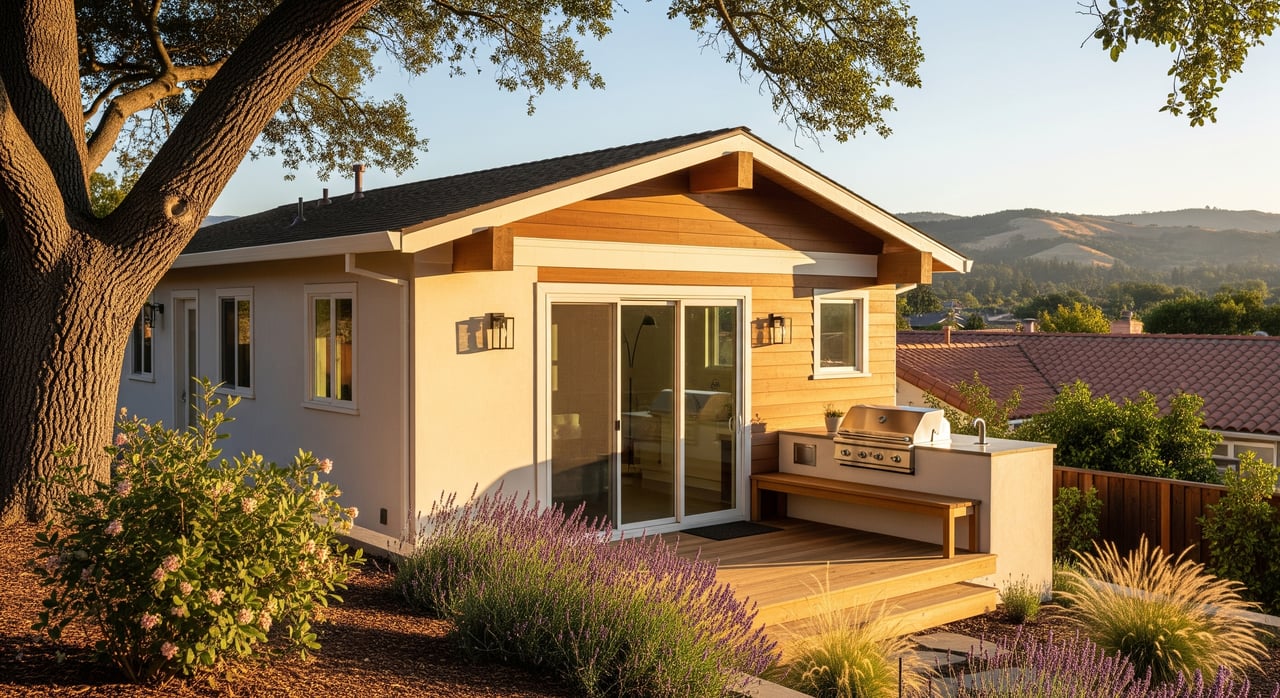
Thinking about adding an accessory dwelling unit to your Pleasanton property for rental income, resale value, or space for loved ones? You are not alone. ADUs are one of the most effective ways to unlock flexibility and long-term value on a single lot, but rules and costs can feel complex. In this guide, you will learn how ADUs work in Pleasanton, what permits you need, what they cost, how to finance one, and the ROI drivers that matter. Let’s dive in.
ADU basics in Pleasanton
An accessory dwelling unit is a secondary home on the same lot as your primary residence. In Pleasanton, you can typically consider four formats:
- Detached ADU: a new, stand-alone structure in your yard.
- Attached ADU: an addition connected to your main home.
- Conversion ADU: space converted from an existing structure, such as a garage or part of the home.
- Junior ADU (JADU): an interior unit, typically up to 500 sq ft, created within your home.
California state law sets baseline allowances for ADUs, including streamlined approvals in many cases, parking relief in certain locations, limits on impact fees for smaller units, and relaxed owner-occupancy rules. Pleasanton applies local, objective standards such as setbacks, height, and lot coverage within those state limits.
How ADU rules work here
State law requires ministerial review for many ADUs, which means approval based on objective standards without a discretionary hearing. Local rules still apply to design and siting. Expect Pleasanton to enforce setbacks, height limits, lot coverage, and objective design standards, and to require building, fire, and utility reviews. Because state and local requirements get updated, confirm current Pleasanton checklists and fees before you submit.
Key takeaways for Pleasanton owners:
- Many ADUs qualify for ministerial review if they meet objective standards.
- Parking requirements are often reduced or waived in specific situations under state law.
- Recent state law removed many owner-occupancy requirements for ADUs. Always verify Pleasanton’s current practice.
- Historic or special overlay districts may trigger extra design review.
Permit steps: from idea to keys
Step 1: Pre-application check
- Contact Pleasanton’s Planning Division to confirm your zoning, lot coverage, setbacks, and any overlays or neighborhood standards.
- Ask if your lot is eligible for an ADU or JADU and what size and height thresholds apply.
Step 2: Site plan and preliminary design
- Prepare a site plan showing existing conditions: property lines, setbacks, trees, easements, and utilities.
- Draft floor plans and elevations that demonstrate compliance with height, setbacks, lot coverage, and parking.
Step 3: Planning review
- Many ADUs are approved ministerially if they meet objective standards.
- If your property is in a historic or special district, additional review may apply.
Step 4: Building permit submittal
- Submit full construction documents: architectural and structural plans, energy compliance (Title 24), MEP plans, foundation and framing details, site drainage, and CALGreen compliance.
- Confirm whether a separate address is required and whether the Fire Department needs a review.
Step 5: Utilities and site work
- Coordinate water and sewer connections with the appropriate provider. Connection and capacity fees may apply.
- Coordinate any electrical service upgrades or a separate meter with your electric utility.
- If grading or stormwater measures are needed, expect additional permits.
Step 6: Inspections and final
- Typical inspections include foundation, framing, plumbing, electrical, mechanical, energy, and final.
- You will need a final sign-off or Certificate of Occupancy before you rent or allow separate occupancy.
Documentation checklist
- Proof of parcel ownership and any recorded documents (easements)
- Site plan, floor plans, elevations
- Structural and foundation plans
- Energy compliance forms (Title 24)
- Tree assessment if protected trees are near the work area
- Utility coordination letters
- Soils or geotechnical report if required for new foundations or sloped sites
Local requirements to expect
- Setbacks and height: detached ADUs typically must meet rear and side yard setbacks. Conversions and attached units may have different allowances under state law.
- Parking: under state law, parking is often reduced or not required in many cases, but confirm replacement parking rules if you convert a garage.
- Owner-occupancy: recent state law generally removed owner-occupancy for many ADUs. Confirm Pleasanton’s current policy and any exceptions.
- Utilities and fees: lateral connections and capacity fees can be a major cost item. Larger ADUs may have standard impact or connection fees, while smaller units may benefit from fee relief.
Timeline: how long it takes
- Plan check: many cities use expedited timelines for ADUs. Expect weeks to a few months for plan review, with total permitting often in the 2 to 4 month range if your plans are complete.
- Construction: a small detached ADU typically takes about 4 to 9 months depending on size, complexity, site work, and contractor availability.
ADU costs in the Tri-Valley
Costs vary widely based on site and design. Regional ranges commonly reported include:
- Basic conversion ADU (garage or interior, about 400 to 700 sq ft): roughly $80,000 to $250,000.
- New detached ADU (about 400 to 1,000+ sq ft): typically $150,000 to $450,000+, with complex or high-end builds exceeding $500,000.
- Per-square-foot figures can range from roughly $250 to $600+ depending on finish level, foundation, grading, utilities, and inspections.
Main cost drivers:
- Site work: grading, retaining walls, and drainage
- Utility extensions: sewer, water, and electric panel upgrades
- Foundation type: slab vs raised vs pier
- Structural complexity and number of kitchens/baths
- Labor and material costs and contractor availability
- Impact and connection fees where applicable
Ongoing costs to plan for:
- Utilities and maintenance
- Insurance adjustments
- Property management if you rent the ADU
- Property tax assessment changes related to new construction
Financing your ADU
Common ways to fund an ADU include:
- Cash
- Home equity line of credit or home equity loan
- Cash-out refinance
- Construction loan or ADU-specific loan products
- Renovation-focused lenders
- Occasional grants or local incentives, including programs tied to affordability or seismic work
Rental income and ROI in Pleasanton
Pleasanton and the broader Tri-Valley are strong rental markets, with steady demand from local employers and commuters who value nearby transit and neighborhood amenities. Actual rents depend on size, finish, privacy, and location.
Typical rental benchmarks to consider:
- Studio or small 1-bedroom ADU: often comparable to small apartment rents in Pleasanton, commonly in the $1,800 to $3,000+ range depending on size and finish.
- Larger 1- to 2-bedroom ADUs: proportionally higher rents and longer tenant demand.
Short-term rentals are regulated in many Bay Area cities, so verify Pleasanton’s current rules before planning an STR strategy.
ROI drivers
Positive ROI conditions:
- High local rental demand relative to supply
- Lower build costs, such as a simple conversion
- Favorable fees and streamlined permitting
- Smart layouts that maximize rentable square footage and privacy
Negative or neutral ROI conditions:
- High site costs from grading, utilities, or structural complexity
- Larger impact or connection fees
- Properties with limited access, privacy, or amenities
- Market downturns or limits on short-term rentals
Resale value and appraisal
An ADU often boosts buyer appeal by adding flexible space for multigenerational living or income potential. Appraisers commonly consider three approaches when an ADU is properly permitted: likely rental income, comparable sales with ADUs, and cost to reproduce. Units with clear permits, a separate entrance, and thoughtful integration typically command more value than unpermitted or awkward conversions.
Tax and legal notes to keep in mind:
- Rental income is taxable. Owners can often depreciate the ADU if it is used as a rental.
- New construction can affect your assessed value. Contact the local assessor to understand how your taxes may change.
- If you rent the ADU, follow California landlord-tenant law and any local rental or STR rules.
Design choices that pay off
Features that improve marketability and rentability in Pleasanton include:
- Full kitchen and bath, separate HVAC controls, and in-unit laundry
- Strong sound separation and clear privacy between homes
- Durable exteriors and low-maintenance finishes suited to local weather
- Natural light, storage, and a private entry or outdoor space
- Universal design elements, such as single-level living and no-step entries, which can broaden your tenant pool and future buyer interest
Common risks and how to reduce them
- Cost overruns from hidden site conditions like drainage, trees, or soils. Build a contingency and get a geotechnical review where needed.
- Permit revisions and utility coordination delays. Start conversations early with Planning, Building, and your utility providers.
- Contractor backlogs. Interview multiple licensed builders and confirm availability.
- HOA rules that complicate ADU approvals or use. Review your CC&Rs early.
Practical tips:
- Get an early feasibility check with Pleasanton Planning to confirm eligibility and constraints.
- Survey recent rents for similar units in Pleasanton and nearby Tri-Valley neighborhoods.
- Include utility connection costs in your cash flow model.
- If a full detached ADU is not feasible now, consider a phased plan such as a JADU or interior conversion.
- Use conservative assumptions for rent, vacancy, and project cost.
Next steps for Pleasanton owners
- Gather parcel documents, past permits, and any recorded easements.
- Confirm zoning, setbacks, and standards with Planning.
- Develop a simple site plan and concept for size, layout, and privacy.
- Request preliminary bids from licensed contractors and confirm utility requirements.
- Model rent, expenses, and loan options to see your break-even and payback timeline.
- Speak with a tax professional about rental income, depreciation, and basis.
If you are weighing an ADU as part of your sale or purchase strategy in Pleasanton, connect with Cindy Alaimo for local market guidance, pricing insight, and timing strategy. Schedule a Complimentary Local Market & Home Presentation Plan.
FAQs
What is the difference between an ADU and a JADU in Pleasanton?
- An ADU can be detached, attached, or a conversion with its own kitchen and bath, while a JADU is an interior unit, typically up to 500 sq ft, created within the existing home.
Do I need parking for an ADU in Pleasanton?
- California law often reduces or removes parking requirements for ADUs in many situations, but you should confirm Pleasanton’s current standards and whether replacement parking is needed if you convert a garage.
How much does a detached ADU cost in Pleasanton?
- Regional ranges for a new detached ADU often run $150,000 to $450,000+, with complex or high-end projects exceeding $500,000 based on site work, utilities, and finishes.
How long does ADU permitting and construction take in Pleasanton?
- Many projects complete plan check within weeks to a few months and finish total permitting in about 2 to 4 months, with construction typically taking 4 to 9 months depending on size and complexity.
Will an ADU increase my property taxes in Alameda County?
- Adding an ADU is new construction that can change your assessed value. The impact depends on the scope of work. Contact the assessor to understand how your taxes may change.
Can I use a Pleasanton ADU for short-term rentals?
- Short-term rental rules vary by city in the Bay Area. Verify Pleasanton’s current policies before planning an STR strategy.
Do I have to live on site if I add an ADU in Pleasanton?
- Recent state law removed many owner-occupancy requirements for ADUs, but you should confirm Pleasanton’s current policy and any exceptions.
What financing options are available for a Pleasanton ADU?
- Owners commonly use cash, a HELOC or home equity loan, a cash-out refinance, a construction or ADU-specific loan, and occasionally grants or incentives when available.